Your homepage is your digital storefront, the first impression most people get of your brand. In a world where users form an opinion in less than a second, stellar website homepage design isn’t just “nice to have.” It’s essential for credibility, user experience, and conversions.
But what exactly separates a great homepage from an average one? Why do some homepages instantly attract and engage visitors, while others leave them confused or clicking away?
In this guide, we break down the must-have elements of effective homepage design, backed by UX best practices and conversion marketing insights, to help you turn your homepage into a high-performing, sales-driving asset.
Table of Contents
1. A Clear, Benefit-Driven Headline
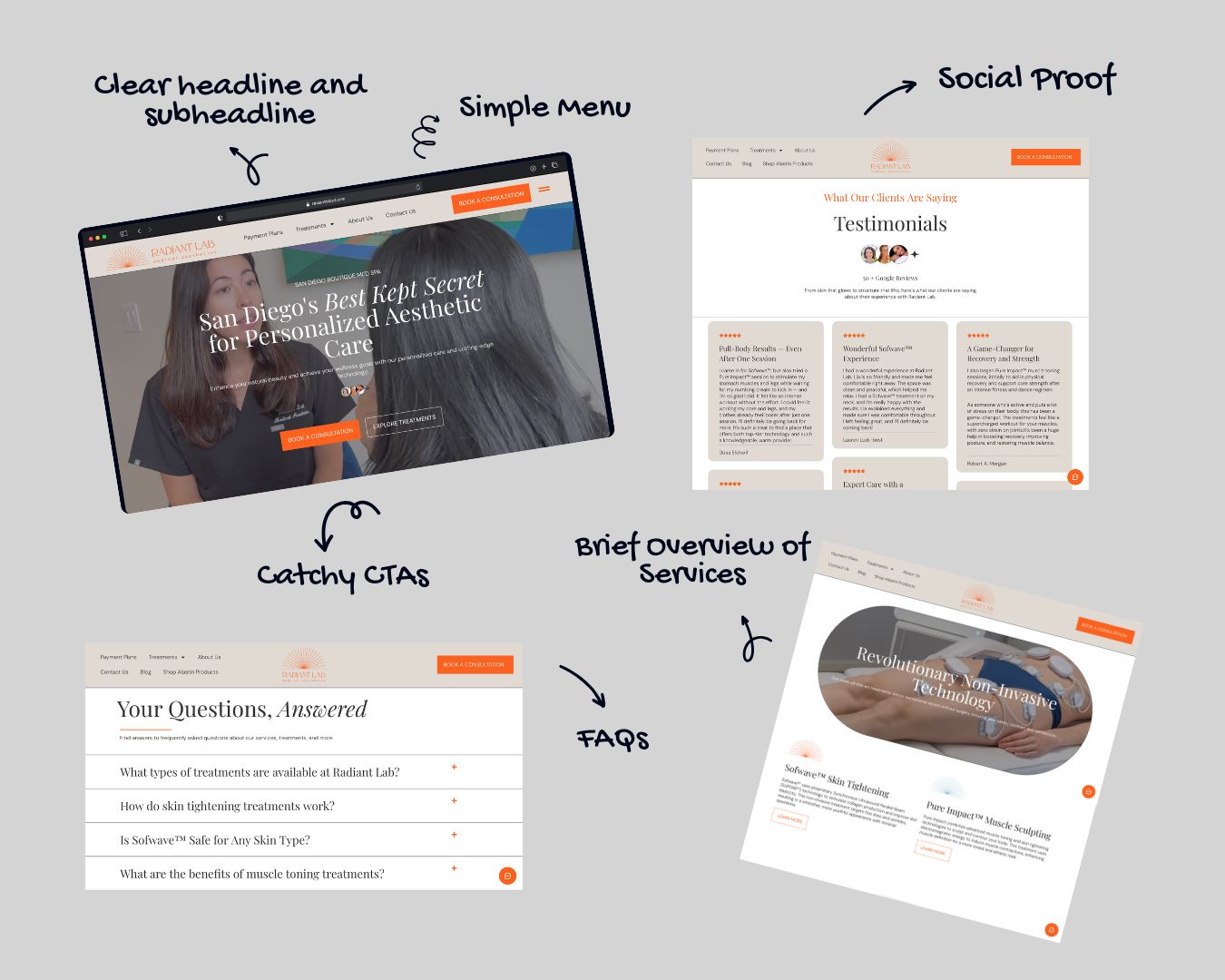
Your headline is the first thing visitors read. It needs to communicate what you do and why it matters, in seconds.
A common mistake: vague slogans that sound poetic but say nothing.
A great Website Homepage Design uses a headline that is:
Clear (no jargon)
Benefit-focused
Audience-specific
Short and impactful
Example:
“Clear, Healthy Skin Starts Here – Expert Dermatology for the Whole Family”
vs.
“Unlocking Beauty and Confidence for Everyone” (…what does this even mean?)
If your visitors cannot immediately understand what you offer, they won’t scroll
2. A Strong Subheadline That Adds Context
Once you’ve grabbed attention, the subheadline provides the details. Think of it as a one-sentence elevator pitch.
It should:
Clarify your service or product
Highlight the value
Encourage the visitor to continue reading
Pairing a clear headline + a contextual subheadline is one of the most powerful combinations in effective homepage design.
3. A Visual Hierarchy That Guides the Eye
A homepage is more than text and images, it’s a visual experience. Proper visual hierarchy helps visitors understand what’s important and what action to take next.
This includes:
Strategic use of size, spacing, and color
Clean typography
Sections organized by priority
Consistent, easy-to-scan layout
Users should be able to skim the page and quickly find what they need. If everything is screaming for attention, nothing stands out, your key message gets lost.
4. High-Quality Visuals That Support Your Message
Great visuals don’t just “look pretty.” They communicate what you offer and reinforce trust. Avoid generic stock photos if possible. Instead use:
Real team photos
Product screenshots
Short background videos
Lifestyle or context-based imagery
Custom illustrations or animations
Choose visuals that tell a story. Your website homepage design should make visitors instantly feel connected to your brand.
5. A Compelling Call-to-Action (CTA)
Every homepage needs a clear next step, ideally above the fold and repeated throughout. Your CTA should feel natural, relevant, and persuasive.
Examples of strong CTAs:
“Book a Free Consultation”
“Book an Appointment”
“Buy Now”
“Start Your Treatment Plan Today”
“See Pricing”
Pro tip: Use one primary CTA and one secondary CTA (for users who need more information before converting), and place them 2–3 times throughout the homepage.
6. Easy and Intuitive Navigation
If people can’t find what they’re looking for, they will bounce, instantly.
Great navigation follows these principles:
- Keep it simple (5–7 main menu items)
- Use intuitive names (Homepage, Services, Pricing, Blog, FAQs, About, Contact, not creative guesswork)
- Include a visible CTA in the header
- Ensure your navigation is consistent across the entire site
- Your homepage serves as the entry point. Navigation serves as the roadmap. Together, they create a smooth user journey.
7. Proof and Trust Builders
In today’s crowded online world, trust is currency. A strong homepage includes credibility indicators such as:
Testimonials
Google reviews
Video case studies
Press mentions
Certifications
Before/after photos
Social proof widgets
Partner logos
Highlighting real results makes it easier for new visitors to believe in your brand and take action.
8. A Brief Overview of Your Services or Products
Your homepage is not the place for long-form content. Instead, offer a concise overview of what you provide, with links to more detailed pages.
This helps users:
Understand what you specialize in
Navigate deeper into the site
Build trust through clarity
Use short blocks, icons, or cards to visually break down your offerings.
9. Benefits Over Features
A common homepage design mistake is focusing too much on features.
Instead, shift to benefits, how your products or services improve your customer’s life.
Example:
Feature: “Membership program with exclusive perks”
Benefit: “Save money while enjoying regular treatments that keep your skin glowing.”
Every element of your website homepage design should answer the visitor’s biggest questions:
“Why should I care?”
“How does this help me?”
10. Fast Loading Speed and Mobile Responsiveness
No matter how beautiful your design is, slow loading times kill conversions. Google reports that 53% of mobile users leave a site that takes more than 3 seconds to load.
To optimize:
Compress images
Use modern formats (WebP)
Reduce heavy scripts
Use reliable hosting
Optimize for Core Web Vitals
Mobile-first design is also crucial: over 60% of all web traffic is mobile, and a homepage must work seamlessly across all screen sizes.
11. Clear Brand Identity
Your homepage should visually communicate who you are, including:
Brand colors
Typography
Tone of voice
Logo placement
Unique value proposition
Personality
A memorable website homepage design is consistent, cohesive, and unmistakably “you.”
12. Optimize for Search
A homepage is one of the most important SEO pages on your website.
Here are a few quick tips to optimize it:
Structure your content with H1, H2, and H3 tags
Use your primary keyword naturally
Include relevant secondary keywords
Add descriptive alt text to your images
Compress and optimize your images for faster page load speeds
Keep your URL simple and concise
Include relevant internal links
Optimize your homepage SEO metadata
Good SEO ensures users find your beautifully designed homepage in the first place.
Conclusion
A great homepage isn’t defined by flashy elements, it’s defined by clarity, usability, and strategy. When your website homepage is built with the user in mind, everything becomes easier: engagement increases, trust builds faster, and conversions happen naturally.
The goal isn’t just to look good, it’s to create an experience that guides visitors exactly where they need to go.
If you focus on the core elements – clear messaging, strong visuals, intuitive navigation, social proof, and fast performance – you’ll have a homepage that not only attracts visitors but turns them into customers.
At Filia Digital, we follow the best practices to create web design that actually converts, helping your website work harder so you can grow your business effortlessly. If you want to turn your website into a conversion machine, schedule a consultation with our team today.